|
ARRL and RRI – Toward One National Traffic System |
|
During the past few weeks, representatives from the NTS subcommittee of the ARRL Board’s Emergency Communications and Field Services Committee (EC-FSC) and Radio Relay International (RRI) have been meeting with the intent of finding commonality with a goal of presenting to the public and public service organizations a National Traffic System with joint oversight, under the leadership and guidance of the reestablished area staffs, reporting to both organizations.
A memorandum of agreement has been under discussion and is near finalization.
One of the provisions will include a monthly column in The NTS Letter by James Wades, WB8SIW, author of RRI's popular QNI newsletter. The first article is found below.
|
|
|
|
Does an amateur radio license qualify one to provide emergency communications services to relief or government agencies? Does possession of two-way radio equipment ensure that the radio amateur is an asset to his community?
A strong argument can be made that the answer to both questions is an unequivocal “no.” In fact, one might even argue that important operational messages in the hands of an inexperienced operator can cause major disruptions to a disaster operation.
Just as a soldier or hunter must practice with a rifle, a radio operator must practice conveying third-party messages on nets.
The proper use of procedural phrases (prowords), the ability to convey and clarify complex terms using the standard phonetic alphabet, and the ability to achieve the brevity and efficiency of net operation does not come naturally, nor can it be learned “on the fly” in times of emergency.
The National Traffic System exists to provide the knowledge and opportunities needed to develop efficient radio communications skills.
Whether one is relaying a routine radiogram or transmitting an important message during a disaster, the process remains the same.
In other words, one should not measure the value of the National Traffic System based on the content of routine radiograms.
Instead, one should measure the value of NTS based on the training it offers.
The skills needed to convey an unfamiliar address, text, or signature are the same skills needed to spell a complex pharmaceutical term or request a quantity of disaster supplies.
Regular participation in NTS and allied traffic nets builds important infrastructure and relationships that can be leveraged as an effective asset in time of emergency.
The procedures used translate seamlessly to “tactical” style nets, such as those common to local ARES® and similar nets.
One needn’t be an “iron-man (or woman)” operator to reap the benefits of NTS participation.
Make a commitment to check into one or two nets per week to represent your area.
Originate a radiogram or radiogram ICS-213 message once or twice per month.
Eventually, proper, standardized procedures will become automatic.
Standardization and practice are essential.
When your house is on fire or a medical emergency occurs, it is reasonable to expect that agency volunteers have the necessary training and practice needed to perform their job safely and adequately.
Likewise, when your community calls upon the Amateur Radio Service to provide supplemental communications or fill in a gap during a communications outage, it has a reasonable expectation that those reporting to assist have the necessary skills to communicate accurately and effectively.
NTS nets provide that training and experience.
There is a renewed interest in organized traffic-handling network operations.
Jump in and assist with the ongoing NTS renaissance while preparing yourself to be of service to your community when the time comes.
– James Wades, WB8SIW
|

|
|
|
Field Day 2025 and the NTS Traffic Handler |
|
Field Day is said to be the highlight of the year for amateur radio operators.
It is held annually on the fourth weekend in June, which this year falls on June 28 and 29. There is something for almost any amateur radio operator.
It is perhaps foremost an exercise in emergency preparedness, one of the primary reasons for the existence of the Amateur Radio Service.
It takes great skill to be able, within a short period of time, to set up multiple stations capable of various modes, and operate without public infrastructure.
While not an official contest, it offers the contester the thrill of making multiple contacts, scoring many points for their club or group.
For those who enjoy outdoor activities such as POTA and SOTA, it is an opportunity to show off their skills in setting up portable stations.
For many, this is also a big social event, offering cookouts and early morning breakfasts.
An important factor, however, may be overlooked, and that is the opportunity to demonstrate the messaging service capabilities of the National Traffic System, especially in an emergency.
NTS operators, as all amateurs, can show off this capability first by publicizing the event, encouraging people to come and see hams in action.
Welcome them and offer information about amateur radio and how it is still very active in today’s world of technology.
A second way is to demonstrate our messaging services that can be available in a disaster or situation when public infrastructure is unavailable.
ARRL encourages this by offering extra points for transmitting formal written messages in the form of radiograms from any Field Day site.
One hundred points can be counted for a radiogram to the Section Manager or Section Emergency Coordinator and another 100 points for 10 radiograms to friends and families, all sent over radio frequencies from the Field Day site.
NTS traffic handlers have a big part in this activity.
Beginning now, when clubs and groups are making their Field Day plans, traffic handlers can reach out to their clubs, encouraging them to take advantage of this activity, not only to gain points but also to help spread the word about amateur radio to others in their communities and beyond.
Offer to help on Field Day, either from the site or from home relaying to traffic nets, or teach club members how to format radiograms, find traffic nets or digital outlets, and how to send these radiograms over the air.
|
|
The Southwest Florida Traffic Net will once again support the Fort Myers Amateur Radio Club with handling radiogram traffic for Field Day scoring. A special FD session of the SWFTN will be called at 16:00 Saturday afternoon, during which the primary function will be to accept scoring radiograms from the FD site. Offsite liaison stations will handle the traffic to either the Digital Traffic Network or to the evening Florida HF Net.
If you’re in southwest Florida for Field Day 2025, please join us at 16:00ET on the N1NQU 146.820 (136.5-) repeater. All traffic and check-ins are warmly welcomed.
The SWFTN calls Monday through Saturday at 10:00 PM ET on the N1NQU repeater in Fort Myers, Florida. See fmarc.net/swftn for details. — Dave Sheppard, W2PAX, SFL STM & SWFTN Manager
|
|
Hello, Treasure Hunters! Twelve stations participated in the March 2025 NTS Treasure Hunt. The following stations successfully completed all four rounds:
WD8SDH Dick, Cambridge OH
K2MJR Michelle, Poughkeepsie NY
KE8HKA Matthew, Ypsilanti MI
N7YD Mark, Redmond WA
N1CVO Shawn, Lowell MA
KN6HXP Warren, Baltimore MD
N3KRX Jerry, Houston DE
W4BZM Michael, Niceville FL
KC3WHU Walt, Metuchen NJ
AE5MI Yvette, Gulfport MS
W1OTW Doggone Dave, Warrensburg MO
KA9IKK Bill, Katy TX
About the March Hunt
Round #1 Ray, KB8GUN
THR1 IS IT MANDATORY TO
PHONETICALLY SPELL THE LAST
NAME OF THE ADDRESSEE QUERY
Answer:
Section 2.2.1.1 of the MPG.
ALWAYS SPELL THESE GROUPS AND USE PHONETICS:
Last names of addressee in address, and in Op Note; Proper names in text; Last names in signature and Op Note; ARL Radiogram numbers spelled out in texts; (ARL FIFTY and SIXTY sound very much alike even letter-spelled!); Fills, as requested.
Round #2 Dan, AC8NP:
THR2 WHAT DOES EME COMMUNICATIONS
MEAN QUERY
Answer:
www.arrl.org
Updated 02/06/24 by KD2ZWN
Communicating over great distances via VHF continues to fascinate many amateurs. EME (Earth-Moon-Earth) communication, also known as "moonbounce," and meteor scatter are two well-known propagation techniques.
Round #3 Glenn, VE1AQF:
THR3 WHAT DOES ARL/RRC SEVENTY
FOUR SATERN 14325 KHZ USB
MEAN QUERY
Answer:
This is a message body text for ARL/RRC SEVEVTY FOUR.
Establish communications with SATERN agency on 14325 KHZ (frequency) USB (mode).
ARL Numbered Radiograms
RRC Numbered Radiograms
Round #4 Jon, N1ILZ:
THR4 WHICH NTS2/RRI NUMBERED RADIOGRAM
REQUESTS MORE EMERGENCY RADIO OPERATORS
QUERY
Answer:
ARL/RRC Nine
ARL Numbered Radiograms
RRC Numbered Radiograms
May Question Treasure Hunt Round 1
THR1 WHEN DOES AN OPERATOR
USE ARL FORTY ONE QUERY
Please send a radiogram to:
JON N1ILZ
EASTHAM MA 02642
The judges will respond with a radiogram back to you, usually within 24 hours of the receipt of your message. Our judges are on traffic nets almost daily. The in-transit time will vary. So, if it has been 4 or 5 days and you do not receive a reply radiogram, try sending a new one with a new message number.
Try to learn about the NTS in your section. Who is your Section Traffic Manager (STM)? The STM can answer your questions on how to move traffic in and out of your section.
If you missed the official Treasure Hunt announcement in the December 2023 issue of The NTS Letter, here is a recap: This is a fun, on-air, multi-step competition in which you will respond to a "judge" with your answer to an initial clue or question via radiogram. The judge will reply via radiogram with the identity of the next judge, along with the next question or clue in the hunt.
If you have any comments or suggestions, please email Dan Rinaman, AC8NP, at ac8np@ac8np.com.
|
|
A reminder that the Virtual NTS Training Net (VNTN) continues to meet on Wednesdays at 7:00 PM Eastern Time. The VNTN URL is bitl.to/3xj4. Anyone interested in message handling is welcome.
No experience required, only an interest in learning.
Want to learn about message handling on CW traffic nets? The Long Island CW Club has a great training program for learning CW, which is a lot of fun, and it also offers a class on using that CW on NTS traffic nets, which is a good way to practice your skills in a very useful activity. You must be a member of the club to participate in these classes, but the nominal fee is well worth it. Check out the club’s website, longislandcwclub.org, for more information about joining, and contact Ed Conway, N2GSL, for details on LICW’s NTS training.
Training on digital voice networks. Bill Leibengood, N8RWF, is working on a “National Traffic System Digital Voice Traffic Training and Information Net.” As many amateurs, including Technician class licensees, are using various digital voice modes, and as conditions on HF can at times hinder traffic relay, it makes sense to develop training on these other modes.
Bill states that “the brilliance of this reflector and network is that it can be accessed by any amateur radio station with almost any of the digital voice modes currently available.
It can also be accessed via EchoLink.
It can be accessed from anywhere in many different ways.” He also points out that this is in no way meant to replace or bypass any of the current NTS structure, but does offer alternatives or, in other words, another tool in the “toolbox.”
Bill continued, “The net could occur either monthly or bi-weekly with multi-purposes: 1) Generate interest in traffic handling and expand to digital voice; 2) Train stations interested in traffic handling; 3) Traffic handler fellowship; 4) Establish a common place for traffic handlers to periodically meet; 5) Establish common ground rules when issues arise; 6) Discuss traffic handling process and procedure; 7) Have fun! Check out the following link (URF106 Universal Reflector) for the Michigan Multiprotocol Reflector.”
|
|
On Book Traffic — What, Why, How |
|
Have you ever cc’d multiple people when emailing at work? If you have, you have used the same technique as formatting multiple radiograms with the same message, but to different recipients, into book traffic. This article will provide an overview of the basic technique, although there are numerous iterations of booking. Basically, any way to save time by condensing common sections of messages or addresses is utilizing this technique.
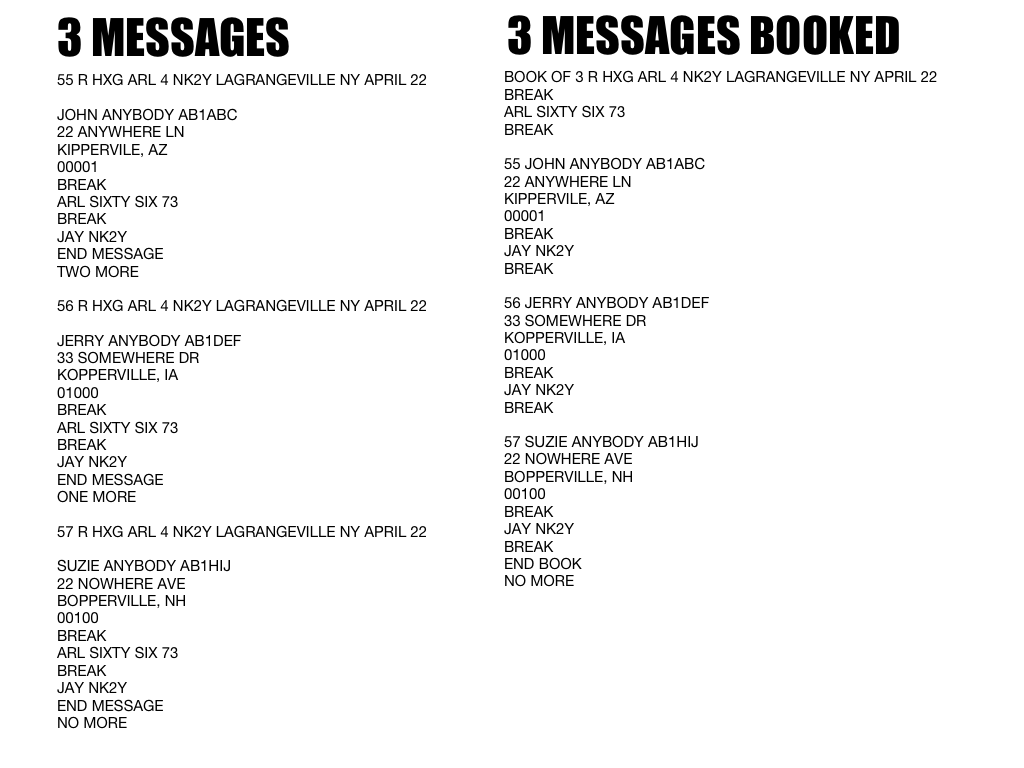
To provide an example, a birthday message to triplets is shown in the diagram.
|
 |
|
|
|
The example on the left shows the three messages created individually.
The message on the right is combined into a book of three. That means that there is one message that is addressed to three different recipients.
Just by looking at the length of the text, you can see that the book (on the right) has fewer characters.
This means that it will take less time to send on a traffic net.
In the example, an ARL numbered message was used, but this technique is especially useful for messages with higher check numbers.
When creating your book traffic, start with the common parts, which are the fixed preamble and the message itself.
Instead of listing a specific message number, include “book of #”, and the message complete with its enclosure break(s). Following the common parts are the addressees.
Here is where the message numbers go — they will be placed into the preamble when the messages are taken out of book format.
The first difference you encounter is when the net control station asks you to list your traffic.
Your reply is “book of #” (# designating the number of recipients of the message.
Our example above is three so the response would be “book of three”), then listing the traffic destinations.
At this point, there are two possible scenarios.
The first is that the book will continue on to the next net in book format, in which case the book will pass from one station to another and remain in this format.
The other scenario is that the book is split up into individual standard format messages, accomplished by the somewhat complex task of multiple stations copying the common parts simultaneously, then the addressees individually.
While this can be an easy way to send many messages at once, thereby saving net time, keep in mind that booking is optional.
If a book is complex and there are many uncommon parts, it becomes confusing even for the experienced receiving operator, and extra time is spent getting fills or explanations.
For the newbie, it could even scare them away.
Composing, sending and receiving book traffic is a rewarding way to handle traffic in a more efficient manner.
Many book messages are the typical “welcome to ham radio” messages to new licensees, but there are so many other possibilities —constrained only by the imagination.
For example, I have used book messages to congratulate students in online CW classes upon graduation, and to thank operators for POTA QSOs after an activation.
Do you have a unique way that you have used book messages? Send me a radiogram and let me know! 73, Jay, NK2Y
|
|
Spotlight – Jim Kutsch, KY2D |
|
|
KY2D with his Seeing Eye® dog Easton. | | |
Jim’s interest in electronics and radio dates back to his childhood when he repaired tube-type radios and TVs for his neighbors.
After losing his sight and part of his right hand at age 16 in a backyard chemistry accident, WA8RDX (SK), who knew of Jim’s interest in radio, asked if he was interested in becoming a ham.
WA8RDX’s mentoring led to Jim’s first license, WN8ZNH, in December 1967. His traffic-handling experience dates back to shortly after upgrading to General in 1968. “At that time, most of the traffic was from military personnel sending messages back to family,” said Jim, “It was very rewarding to deliver those messages.” Regular participation in the West Virginia phone and CW nets resulted in net control positions with both nets.
|
|
In college, Jim applied his CW knowledge to facilitate completing computer science classes as a blind person.
He wrote software to produce Morse computer output from a clacking teletype and a mainframe computer alarm.
He was an active member of the West Virginia University ham radio club and taught Novice classes every semester to college and high school students.
While at the University of Illinois from 1974 to 1976, he applied his ham radio and electronic background to his Ph.D. dissertation project to develop the first talking computer terminal for blind computer users.
It was built on the Altair 8800, one of the first personal microcomputers, again extensively using computer-generated Morse output while developing the speech software.
Ham radio activities followed his professional life across several states.
He was a professor of computer science in West Virginia, worked at Bell Labs in New Jersey, held executive positions with AT&T’s Universal Card Services, Cincinnati Bell, and Convergys, all in Florida, and served as President & CEO of The Seeing Eye in New Jersey for 13 years, where he also was trustee of W2TSE, the ham station for students staying on campus while training with Seeing Eye® dogs.
A life member of ARRL, Jim held various appointments as ORS, Net Manager, and NNJ STM.
Currently he is the Maine STM and Eastern Area TCC Cycle 2 Manager. He is active on Maine’s phone and CW nets, on First Region’s phone and CW nets, on the Eastern Area Net, and on the Digital Traffic Network.
He is the Radio Relay International Eastern Area Digital Manager and runs the DTN Eastern Area Hub.
Outside of traffic handling, Jim’s interests include a bit of chasing DX plus AllStar Link, AMPRNet 44Net addressing, and Raspberry Pi computers.
Jim is now retired and living in Maine.
|
|
The National Traffic System® (NTS®) is a network of amateur radio operators who move information during disasters and other emergencies.
General messages offering well wishes also move through the NTS® to help test the system and to help amateur radio operators build traffic handling skills.
While the NTS® is primarily set up to serve the United States and Canada, it is possible to move traffic internationally through the NTS® through various local, regional, area, and international network connections.
NTS 2.0
NTS Manual
NTS Methods and Practices Guidelines
Handling Instructions
Numbered Texts
Form Encoding Rules for Form
|
|
Sign Up to Receive The NTS Letter |
|
The NTS® Letter is published monthly and is free of charge to ARRL members. Subscribe: www.arrl.org/opt-in-out
If anyone has not received copies of The NTS Letter by email, be sure to check www.arrl.org/opt-in-out
to confirm that you are opted in. If you don't see The NTS Letter listed among the publications you are opted into, click on "Edit," and you will have the opportunity to check the box to receive The NTS Letter. If you have missed any issues, you can find them all at www.nts2.arrl.org/nts-letter-issues
as well as on the ARRL website.
Editor: Marcia Forde, KW1U, Section Traffic Manager -- Eastern Massachusetts, Western Massachusetts, and Rhode Island
ARRL Director of Emergency Management: Josh Johnston, KE5MHV
|
|
NTS® is a program of ARRL The National Association for Amateur Radio®. No other organization works harder than ARRL to promote and protect amateur radio! ARRL members enjoy many benefits and services including digital magazines, e-newsletters, online learning (learn.arrl.org), and technical support.
Membership also supports programs for radio clubs, on-air contests, Logbook of The World®, ARRL Field Day, and the all-volunteer ARRL Field Organization.
|
|
The
NTS Letter is published every month (12 times each year). ARRL members may subscribe at no cost or unsubscribe by editing their Member Data Page at
www.arrl.org/opt-in-out.
Copyright © 2025 American Radio Relay League, Incorporated. Use and distribution of this publication, or any portion thereof, is permitted for non-commercial or educational purposes, with attribution. All other purposes require written permission.
|
|



