|
New Recognition Award Certificates |
|
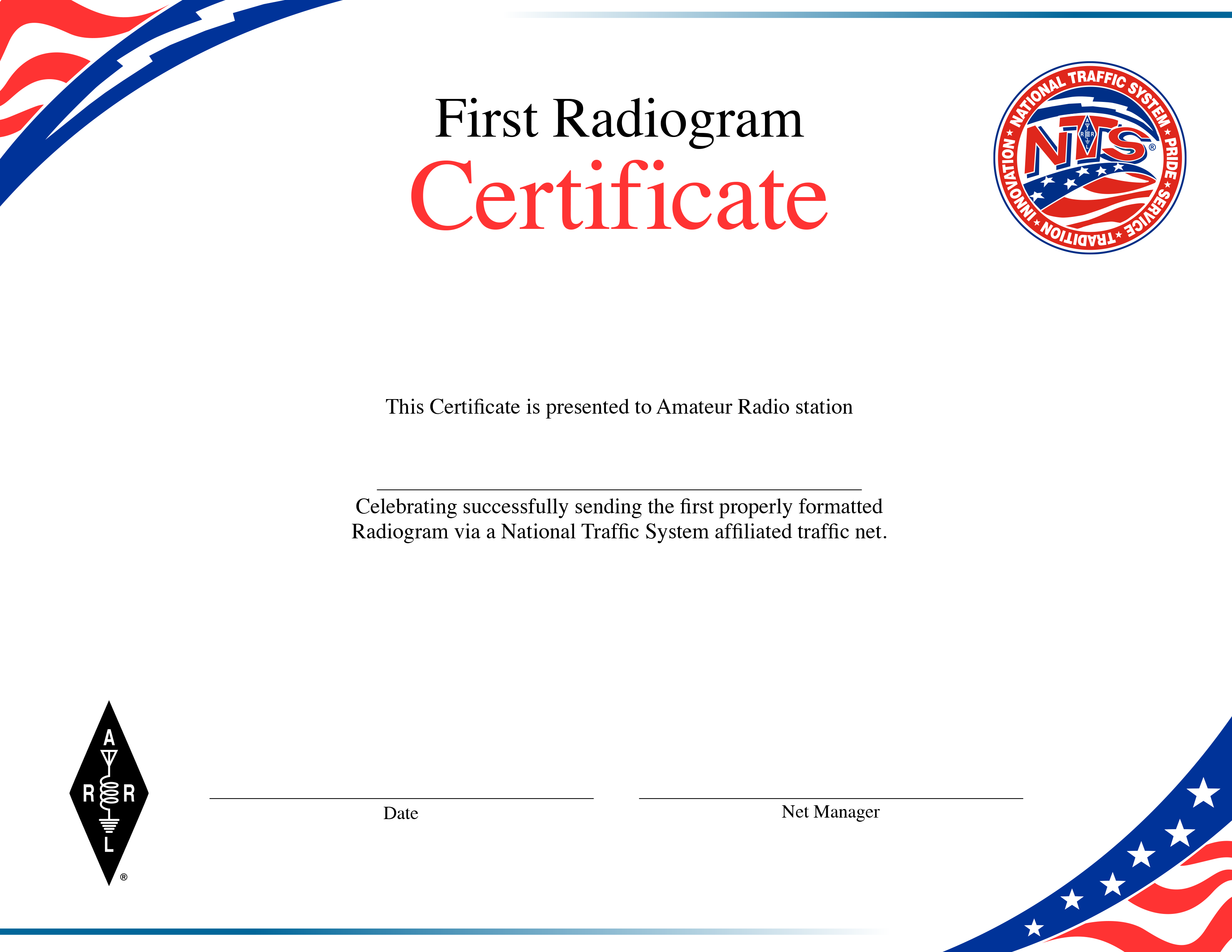
In a previous issue of The NTS Letter, we reported on the efforts of one of the NTS committee working groups to create a series of certificates (such as the one shown below) to recognize and show appreciation to traffic handlers for their time, effort, and dedication in support of the National Traffic System®. These new ARRL-authorized certificates will generally be awarded and available for download by Section leadership within each Section.
A new NTS participant who has been undergoing training can receive a certificate from a net manager for successfully sending his/her first properly-formatted radiogram via a National Traffic System affiliated net.
To encourage greater cooperation between NTS and the Amateur Radio Emergency Service (ARES®), an award can be given by a Section Manager, in cooperation with the Section Traffic Manager and Section Emergency Coordinator, to an NTS operator for handling message traffic in association with official ARES activity during or in preparation for emergency events.
There is a special certificate award for an Official Relay Station of the Year, as determined by a Section Traffic Manager in any Section, for an ORS in his/her Section who has gone above and beyond with respect to traffic handling in a way that furthers the National Traffic System mission, objectives and participation.
Also included are certificates for participation in local and Section nets, for serving as a net control or alternate net control station as well as Net Manager and Section Traffic Manager.
Certificates for participation in region and area nets and the Transcontinental Corps (TCC) will be made available at a later date.
For a little fun for those who enjoy a challenge, a certificate will be awarded to those who personally receive a radiogram from all 50 US states. Two additional awards that will be offered by ARRL Field Services will include the Brass Pounders League (BPL) medallion, which has been available for many years, and a new Challenge Coin.
Details on all awards can be found at https://nts2.arrl.org/recognition-awards.
|
 |
|
|
[Effective June 1, 2025, participants in the National Traffic System will be seeing a new message precedence, introduced by Radio Relay International (RRI). I asked James Wades, WB8SIW, to explain some background on the reasoning behind this new precedence and the benefit to the NTS that is hoped to be achieved.
RRI, in its relatively short existence, has done much to add value to the NTS.
This is one such initiative.
—Ed.]
In recent years, the National Traffic System® has confronted two apparently conflicting imperatives, one of which is the requirement to build an infrastructure around a volunteer base, and the other is the more immediate requirement to provide a customer service in the form of accurate and timely message delivery.
The NTS® network topology and many of its policies, whether explicit or evolved, were built around the old telecommunications paradigm of the postal service and land-line telephone network in which costs were associated with message delivery, such as toll charges for Inter-LATA or long-distance telephone calls.
Therefore, the plan has been to move a radiogram as close to the addressee as possible.
In doing so, the volunteer incurred no delivery costs and, ideally, the volunteer base would expand based on need.
Problems arose, however, when volunteers (outlets) were not available near the radiogram’s addressee. A routine message would propagate through the network efficiently, only to be held at the state/section level nets awaiting an outlet near the addressee, sometimes for days.
In other words, the basic system worked well, but the lack of volunteer support resulted in poor customer service.
As bulk messages became common, a certain “malaise” developed. Some operators, perceiving these messages as unimportant, would simply choose not to deliver messages for which there was no outlet.
This had a corrosive effect on volunteer morale that manifested itself in the form of poor customer service and harm to the reputation of a potentially valuable program.
As a result, a solution to this problem had to be found that balanced the imperative of customer service against ensuring that nets remained active and interesting to volunteers.
The solution developed was a new classification of radiogram message which prioritized customer service called the “certified radiogram.”
The certified precedence is a class of routine message that sets an expiration date/time before which the message must be delivered, regardless of its location within the network.
It recognizes the reality that we are operating in a new telecommunications environment in which multiple options for toll-free delivery of messages is the norm.
The goal is to ensure timely delivery of unique (non-bulk) radiogram messages, thereby providing both active traffic handlers and new customers with an assured level of timely and accurate delivery.
While the goal remains to get the message as close as possible to the addressee, this new policy recognizes that this is not always realistic.
Therefore, the certified message must be delivered within 48 hours of the date-time group in the message preamble regardless of where it stands in the network.
The certified radiogram (precedence “C”) is to be used only for unique, personal or organizational messages in which there is a direct personal or transactional relationship between the originator and addressee and in which case the address information is complete and known to be timely and correct.
Common-text messages in which address information is harvested from on-line databases are prohibited from using the “certified” precedence and must remain in the “routine” precedence category.
A more specific definition of the certified message, along with an explanation of how it differs from “bulk” (“canned”) messages, is available in the following Radio Relay International bulletin:
www.radiorelay.org/files/news/Certified_Radiogram_Implementation_Announcement_2025-5-26.pdf.
The Digital Traffic Network (DTN) is the preferred method for the origination or relay of certified messages. However, certified messages may be originated or relayed via any method within the traffic system. A special DTN “virtual pipeline” staffed by RRI Certified Radio Operators (CROs) will be used to route certified messages to their destination. The CRO will then be responsible for ensuring that traffic is relayed to a reliable operator with the necessary skills to ensure accuracy and who is willing to adhere to the guidelines and procedures defining delivery methods. A similar process applies to the Winlink-RRI region gateways to ensure the highest quality of customer service. More information on the RRI Certified Radio Operator program is available at www.radiorelay.org. —James Wades, WB8SIW
|

|
|
|
Radiogram Portal Challenge |
|
Phil Temples, K9HI
The traffic handling community has been equipped with an exceptional tool known as the Radiogram Portal, written by Jonathan Taylor, K1RFD, which allows third parties to deposit a message for origination and delivery via the National Traffic System.
The Portal is supported by a cadre of registered traffic handlers (“radiogrammers”) who check the site daily and pick up any messages for origination.
Even though we’re beginning to promote the use of the Portal to the general public, activity is slow on some days.
We need more messages to “keep the system lubricated.” There is no reason why regular traffic handlers can’t take advantage of the portal’s capabilities and boost radiogram traffic while also having fun at the same time.
All traffic handlers (and non-traffic handlers) are invited to take the Portal Challenge. Log into the Portal each day and leave a message destined for a ham or non-ham, friend or family member.
Those who qualify by depositing one message each day from July 1 through July 28 will receive a special certificate and acknowledgement in the August 2025 issue of The NTS Letter. This is a great way to demonstrate how the public can be served by the National Traffic System and amateur radio! To qualify, you must introduce at least one message onto the Portal each day for pickup and origination by a qualified radiogrammer.
Remember, in this particular situation, you are not the station of origin but rather are acting as a “third-party” and therefore your message will not count as an “origination” or “sent” point in your Station Activity Report (SAR).
The Radiogram Portal URL is at nts2.arrl.org/radiogram.
|
|
|
|
National Traffic System Training and Information Net (NTSTIN) |
|
The National Traffic System Training and Information Net (NTSTIN) will begin June 14, 2025, at 4:00p ET (1:00p PT) on the Eastern Michigan Linked Repeater Network (Universal Reflector 106A). The net will continue to meet on the 2nd and 4th Saturday of every month at 4:00p ET (1:00p PT).
The NTSTIN is a digital voice traffic net designed to provide a relaxed platform for amateur radio operators interested in learning how to handle radiogram traffic, a place for Technician-class operators who do not have access to a local VHF traffic net an opportunity to send and receive radiograms, and, for the more experienced operators, an opportunity to discuss matters of traffic handling and to assist new operators in their learning process.
Eastern Michigan Linked Repeater Network (Universal Reflector 106A) Connection Information:
- Wires-X 43148
- YSF Reflector 92160
- DMR XLX106 - Talkgroup 4001
- DMR TGIF Talkgroup 99846
- D-STAR Reflectors REF106A - XRF106A - DCS106A
- P25 9846
- NXDN 9846
- M17 URF106A
- Allstar #501682
- EchoLink AD8DP-L #878385
Please see and subscribe to the National Traffic System Training and Information Groups.io page for updates, to provide information and for additional information as we build it. —Bill Leibengood, N8RWF
|
|
No Treasure Hunt in June. All May THR1 entries must be sent by June 1. See the July issue of The NTS Letter for May results and the July hunt THR1 question.
|
|
Ham Radio at Girl Scout STEM Fest |
|
Jessie Kneeland, KC1SLQ
I’ve been involved with Girl Scouts for many years and became a ham two years ago.
Recently, I had the opportunity to combine both interests at a STEM Fest organized by our local Girl Scout council in eastern Massachusetts.
At this annual event, businesses and organizations involved in science, technology, engineering, and mathematics host tables with hands-on activities for Scouts of all ages and their grown-ups. The event is distributed throughout the property of a Girl Scout camp, so participants wander around and discover the various stations.
I’d hosted a table before but wanted to try something radio-themed. I initially planned to focus on traffic handling; we would let the Scouts compose radiograms to their families and we would send the traffic out from the site as a demonstration of the public utility of ham radio.
After reaching out to the local traffic-handling community, I gathered the first few volunteers.
Some of us would be on-site to set up a station and help the Scouts compose messages.
Others would be at home and ready to receive the traffic.
|
|
Through outreach to local clubs, we collected more volunteers and added activities.
The event was particularly successful because we had so many volunteers with different roles.
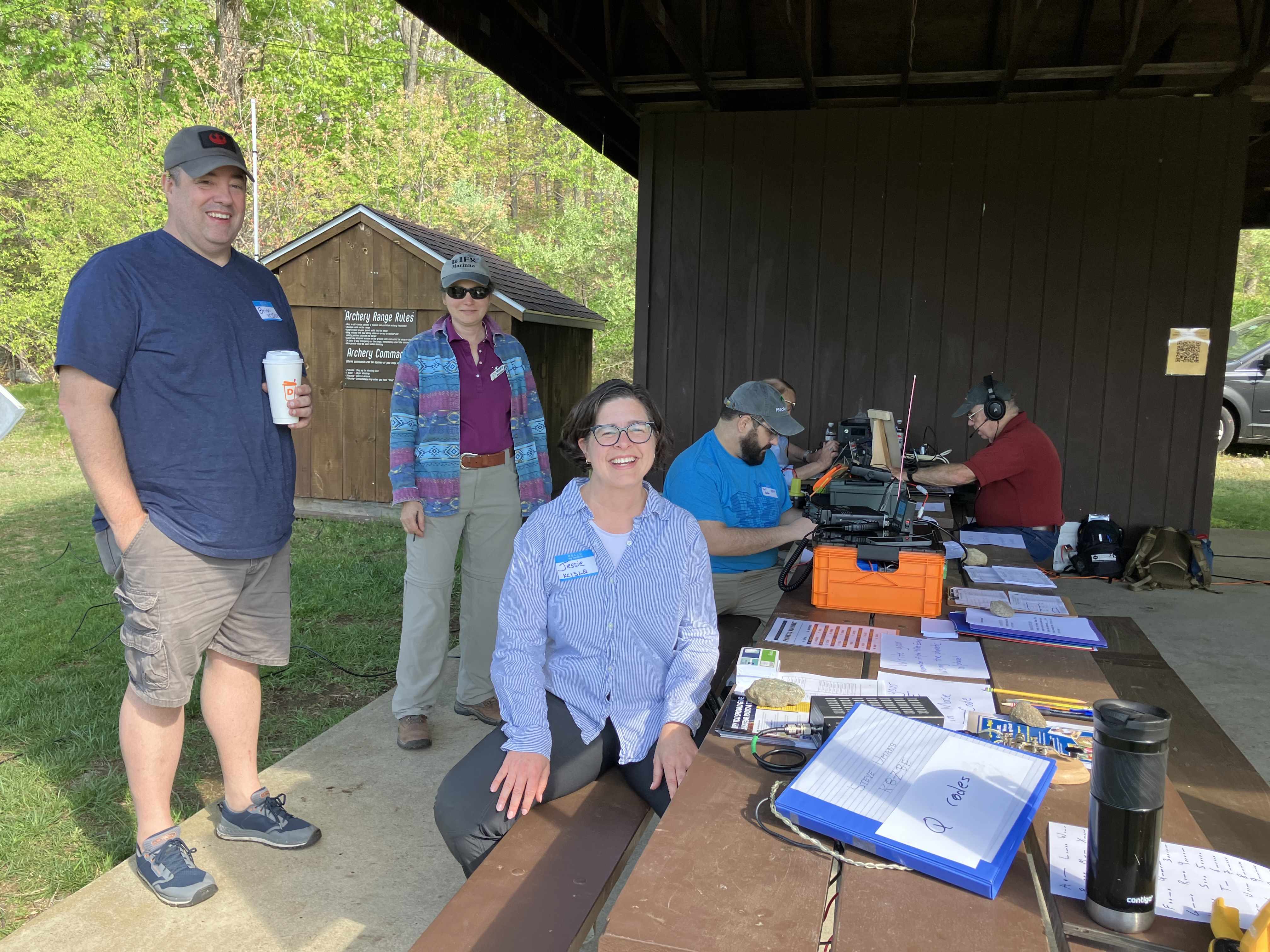
Marinna, W1FX, greeted Scouts and their adults as they approached our area, fielding questions and directing them to the activities.
Steve, K8ZBE, and Tom, AA1TS, set up an HF station with impressive-looking hexbeam and delta loop antennas.
Though band conditions weren’t great, they helped Scouts make contacts and used a Geochron map to explain how far the communications can reach.
Mindy, KM1NDY, set up an oscillator and played Morse Code games, trying to guess the names the Scouts tapped out (with surprising success!). Brian, KC1OOH; Neil, N1HAN, and I (Jessie, KC1SLQ) helped participants draft radiograms and sent them out via voice and digital VHF stations.
Some Scouts also wanted to talk on the radio themselves, and of course we gave them the chance! Ralph, N1LAH; Marcia, KW1U, and Nancy, KC1NEK, all participated from their home stations elsewhere in Massachusetts and Rhode Island, receiving our radiogram traffic and chatting over the radio with eager Scouts.
Overall, the event was loads of fun for volunteers and Scouts alike.
We had a great location under a picnic shelter with plenty of nearby field space to set up antennas, and AC power that gave us extra flexibility.
We had a surfeit of radios and plenty of volunteer enthusiasm, too.
We will definitely participate in the STEM Fest again next year.
For anyone looking for ways to share your love of ham radio within your community, consider looking for events hosted by Scouts, schools, or other education-oriented groups where you can host a table or booth.
It’s a great way to make connections in your local community and perhaps inspire a future ham!
|
|
Helpful Hints for CW Traffic Operators |
|
CW nets remain an important part of the National Traffic System due to the simplicity, efficiency, and the minimal occupied bandwidth of CW.
Many CW traffic operators enjoy the art and skill of traffic handling so much they remain active on nets for decades.
For those new to CW nets, here are a few helpful hints to greatly improve efficiency:
Understanding the QN signals: The QN signals were first developed on the Michigan QMN Net during the 1930s by operators who had a strong professional background in police radiotelegraph circuits, maritime work, and so forth.
These men were interested in efficiency and designed the QN signals accordingly.
Therefore, the third letter in a QN signal is often closely associated with its meaning.
For example, “QNI” means “check-in”, and “QNX” means “you are excused,” and so forth. Most new CW traffic operators need to know only a few of these specialized QN signals to get started.
Signal reports: As a rule, the operator receiving a radiogram establishes contact.
Once contact is established, he or she then indicates that they are “ready to copy” using the Q signal “QRV.” However, a good habit is to also give a signal report so the operator sending the radiogram can adjust their speed and sending method to the conditions experienced by the receiving operator.
This is done using the Q signal “QRK,” which indicates received signal quality on a scale from 1 to 5. For example, if the operator receiving a radiogram sends “de W6RRI QRK2 QRV K,” this tells the sending operator that their signal is “poor” on the other end of the circuit.
The operator sending the radiogram can then adjust their speed and spacing appropriately.
They might repeat the occasional difficult word or group or otherwise accommodate the poor conditions.
Minimizing “fills”: Speaking of sending a radiogram, the professional operator will often “spoon feed” a message under less-than-optimal conditions or when the possibility of confusion arises.
This means increasing the space between words or groups in a message to give the receiving operator a bit of extra time to process the incoming Morse.
Likewise, CW traffic operators may want to take the advice of Walter Phillips, a famous press telegrapher and founder of United Press, who wrote, “difficult names or words should be sent very slowly without repetition.
Paradoxical as it is, it isn’t the time one makes, but the time one loses that really counts on a circuit.” With time and experience, one will develop an intuitive understanding of these concepts.
A good operator can make just the right adjustments to their sending to accomplish the task.
—James Wades, WB8SIW
|
|
NTS traffic handlers provide a message transport system similar, for example, to the postal system, receiving messages and forwarding them on the way to destination delivery.
Just as the postal system has its share of non-deliverable mail, so too the NTS has experienced, for a variety of reasons, a large number of messages that are never delivered.
However, an amateur radio operator has an added responsibility to notify the sender that his/her message was unable to be delivered.
What does one do? There is a saying that there are only three actions a traffic handler can take regarding a message for which one has assumed responsibility: RELAY IT, DELIVER IT, OR SERVICE IT.
An ARL (or RRC) numbered radiogram makes this rather easy.
For example, ARL SIXTY SEVEN states “Your message number _____ undeliverable because of _____. Please advise.” You need only to fill in the blanks.
For example, a radiogram to the station of origin would only need to say “ARL SIXTY SEVEN 123 PHONE DISCONNECTED” or whatever the reason might be.
Of course, a diligent traffic handler might try other methods besides a telephone call to deliver a message, based on information available.
Often an email address is provided, but if sending an email, remember to request an acknowledgement of receipt.
For the recipient, it only requires a click of the reply button which then lets you know the message was delivered and not sitting in some unused or rarely used email account inbox.
This request for acknowledgement might also be tried with other methods of delivery.
When able to make a message delivery, it is important to remember to translate any ARL or RRC numbered radiogram.
While relaying a message we do not change anything in the text.
However, in delivering a message, remember it needs to be understood by the recipient who will not know, for example, what ARL FIFTY means.
|
|
Spotlight – Shawn Dodds, N1CVO |
|
My dad was a mechanical engineer whose hobby had been electronics (radio/TV) since he was a teen.
He was into crystal radios, and he helped me to build my first one, using a chunk of galena I chipped out of the wall of a lead mine in northeast Oklahoma.
Eventually, he got a RadioShack DX-150 shortwave receiver, which fascinated me, to be able to hear people around the world.
I also heard hams talking and asked Dad about them.
He worked with a ham (Gordon, W5UCJ, SK) who provided a study path for me.
Much of that study revolved around the ARRL Handbook for the technical aspects.
For Morse code, my dad purchased a TG34A Army Morse code training machine.
I studied and learned the code up to what I thought was 8 wpm. When I went to Gordon to take my Novice test, he tapped out a question with his key and oscillator.
I verbally answered. His jaw dropped and he said he was sending at about 13 wpm. The TG34A was mis-calibrated. He turned me away and told me to study for General while keeping up my code speed.
Six months later, I got my General in 1969 at age 14, call sign WB5CFZ. Gordon, a Navy MARS member, then sold a Swan 240 to my dad (for me) and suggested I start listening to Navy MARS traffic nets to see if that interested me, and it did.
I joined MARS, was trained, and had a great time handling traffic to/from members of the military and their friends/families in the Tulsa, Oklahoma, area.
It was very rewarding, and I felt like I was providing a useful service for our military and their families.
Regrettably, any paperwork from that part of my life is long gone.
I went off to college and studied electronics engineering, leading to a bachelor’s degree. That led me to a job in Massachusetts.
My interests and hobbies shifted away from ham radio, but I always renewed, eventually getting the call sign N1CVO. I was off the air for 30 years, and upon retiring decided to get back into the hobby in 2022. That restart was with a handheld radio, which I used to get on repeaters near me.
I’m HF-challenged, living in a townhouse condo now.
One night, I came across a traffic net and thought to myself “Hmmm, that’s very familiar.” Eventually, I checked in and found that Bob, KC1KVY, was doing weekly training sessions on another repeater I couldn’t hit with RF but could with Echolink.
I became a regular on the local VHF/UHF network traffic net and found that delivering the "welcome" messages gave me a sense of purpose, and I love chatting with the new hams to whom I deliver the messages.
It also gives me a chance to let Techs know that this is a part of the hobby in which they can get involved with entry-level equipment. In fact, I’ve delivered messages to a number of new hams who are now handling traffic.
Very encouraging! Also, more hams trained in formal traffic handling will be beneficial in actual public service, emergency or welfare situations.
Eventually, I received an appointment to the ORS role and later started as NCS on a local net.
I was handling quite a bit of traffic, and folks started asking me questions after the net.
I love teaching those who want to learn; and experience as a lab teacher in college and as presenter at user groups during my work career has helped with that passion.
That led me to jump at the chance to train folks on the recently formed Virtual NTS Traffic Net (VNTN), the brainchild of Phil, K9HI. Marcia, KW1U, has been NCS for most sessions. There are many new Tech licensees who are not in a location with local VHF/UHF traffic nets. The VNTN provides NTS training to those Techs (and others) so that when they upgrade to General, they can get on HF traffic nets having had some training already. So far, it’s been challenging but successful. We currently have four sessions per month and then start over with the basics. The trainees vary in experience from “zero” to “digital only” to “a few years.” One big challenge is keeping the more experienced folks from getting bored while also ensuring that the newbies aren’t overwhelmed. The locations of attendees range across the Western, Central and Eastern Areas, as well as the Philippines. We encourage and have handled "live" traffic so we can go beyond the simple training radiograms. Lately, more "experts" from across the country have joined to see how it’s going, and to maybe start something similar in their area. We hope that the concept takes off nationwide. I’m also hoping to conduct some special training sessions for those Field Day operators who want to potentially get another 200 points for their clubs by originating formal messages from their Field Day sites. Those details will be forthcoming in a post on the VNTN groups.io page at groups.io/g/vntn.
When I first retired, I thought “what am I going to do to fill my days?” Traffic handling and training has filled that void to the brim, and I’m loving it.
|
|
The National Traffic System® (NTS®) is a network of amateur radio operators who move information during disasters and other emergencies.
General messages offering well-wishes also move through the NTS® to help test the system and to help amateur radio operators build traffic handling skills.
While the NTS® is primarily set up to serve the United States and Canada, it is possible to move traffic internationally through the NTS® through various local, regional, area, and international network connections.
NTS 2.0
NTS Manual
NTS Methods and Practices Guidelines
Handling Instructions
Numbered Texts
Form Encoding Rules for Form
|
|
Sign Up to Receive The NTS Letter |
|
The NTS® Letter is published monthly and is free of charge to ARRL members. Subscribe: www.arrl.org/opt-in-out
If anyone has not received copies of The NTS Letter by email, be sure to check www.arrl.org/opt-in-out
to confirm that you are opted in. If you don't see The NTS Letter listed among the publications you are opted into, click on "Edit," and you will have the opportunity to check the box to receive The NTS Letter. If you have missed any issues, you can find them all at www.nts2.arrl.org/nts-letter-issues
as well as on the ARRL website.
Editor: Marcia Forde, KW1U, Section Traffic Manager -- Eastern Massachusetts, Western Massachusetts, and Rhode Island
ARRL Director of Emergency Management: Josh Johnston, KE5MHV
|
|
NTS® is a program of ARRL The National Association for Amateur Radio®. No other organization works harder than ARRL to promote and protect amateur radio! ARRL members enjoy many benefits and services including digital magazines, e-newsletters, online learning (learn.arrl.org), and technical support.
Membership also supports programs for radio clubs, on-air contests, Logbook of The World®, ARRL Field Day, and the all-volunteer ARRL Field Organization.
|
|
The
NTS Letter is published every month (12 times each year). ARRL members may subscribe at no cost or unsubscribe by editing their Member Data Page at
www.arrl.org/opt-in-out.
Copyright © 2025 American Radio Relay League, Incorporated. Use and distribution of this publication, or any portion thereof, is permitted for non-commercial or educational purposes, with attribution. All other purposes require written permission.
|
|