|
ARRL – RRI Memorandum of Understanding |
|
|
|
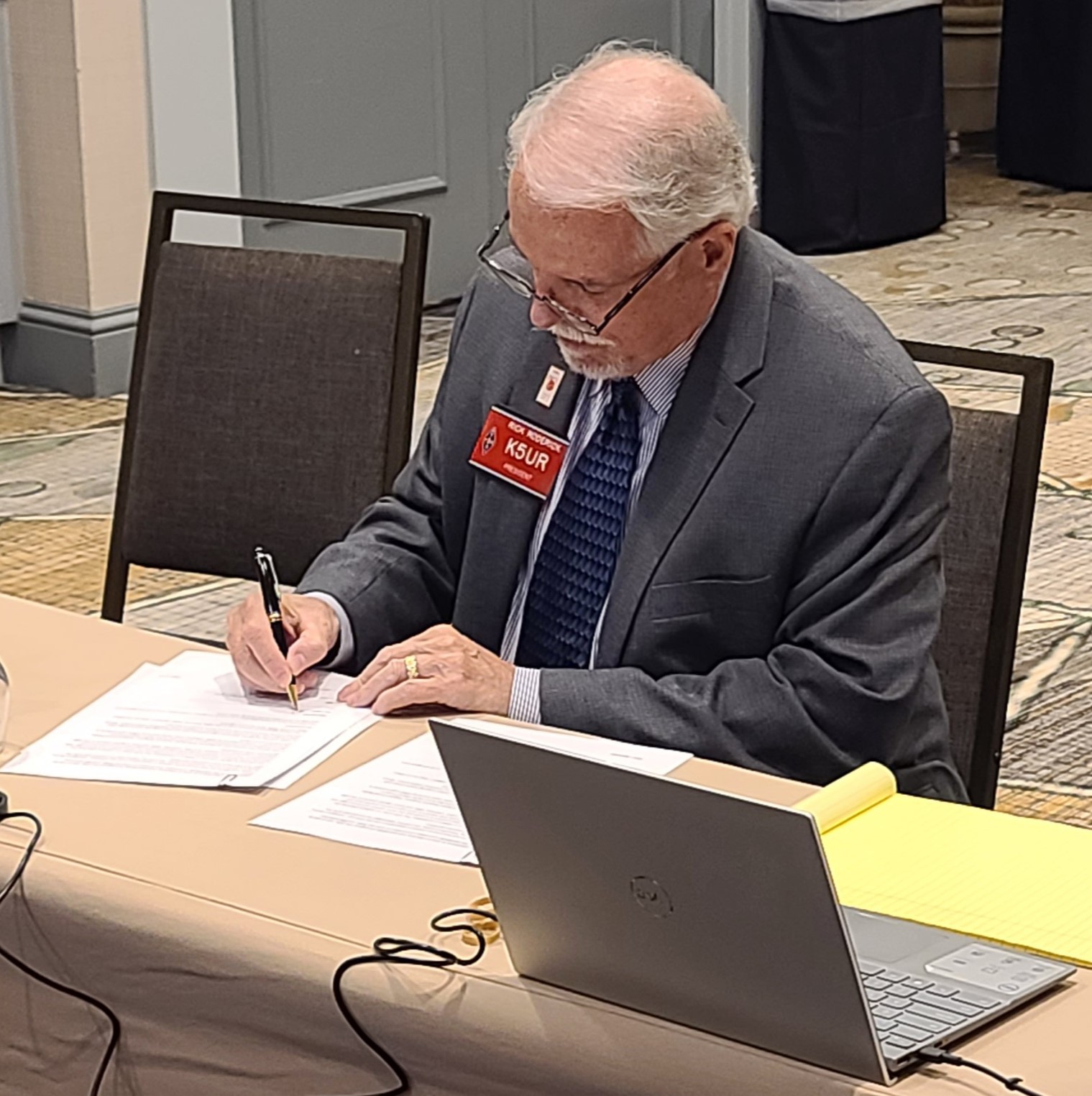
ARRL President Rick Roderick, K5UR, signs memorandum of understanding between ARRL and RRI. [Photo courtesy of Phil Temples, K9HI] | | | |
|
[ARRL The National Association for Amateur Radio (ARRL) and Radio Relay International (RRI) formalized their relationship with the signing of a Memorandum of Understanding (MOU) during the recent semi-annual meeting of the ARRL Board of Directors.
Both organizations will work together to further improve and promote the National Traffic System (NTS). Many thanks go to Phil Temples, K9HI, ARRL New England Division Vice Director and Chair of the NTS subcommittee of the Emergency Communications - Field Services Committee (EC-FSC), and James Wades, WB8SIW, Board Chairman of RRI, along with Scott Yonally, N8SY, Chair of EC-FSC, for their efforts in bringing this about.
Chairman Wades writes about the cooperative efforts –Ed.]
Radio Relay International was formed in 2016 in response to what had been seen as a long decline in NTS activity.
Over several decades, NTS had become mostly invisible in the broader Amateur Radio Service, and few initiatives had been developed to encourage continued evolution of the system.
It was therefore the goal of the RRI founders to correct these deficiencies while leveraging the value of NTS as a modern and relevant public service communications asset.
Thanks to excellent support from the traffic-handling community, the improvements to NTS didn’t go unnoticed, resulting in renewed support for the program by ARRL leadership.
The result was the creation of a new ARRL NTS2.0 Committee, the goals of which were closely aligned with those of RRI.
As a result, it seemed logical and beneficial to develop a Memorandum of Understanding between our two organizations.
The purpose of this MOU is to encourage cooperation while preventing the development of conflicting or duplicative standards.
Most importantly, both ARRL and RRI agree that we must work together to further modernize NTS while restoring its role as a vital component in the Amateur Radio Service.
Within the context of this new spirit of cooperation, it is recognized that ARRL retains an extensive field service organization of immense value.
Along with this infrastructure comes the many local relationships ideal to establishing the “last mile” capabilities essential to an effective communications process.
It is also recognized that RRI has driven an important evolutionary process, not just within NTS, but in the field of emergency communications in general.
The extensive work product of RRI offers a tested and proven plan for continued NTS evolution.
It is no surprise that the Amateur Radio Service of today is much more diverse than it was decades ago.
Some of those obtaining FCC licenses are doing so to support their own interests or to obtain access to infrastructure.
Others do not see themselves as part of a community of radio amateurs.
Within this environment, developing consensus and cooperation is essential to establishing an effective volunteer base.
Programs that unify efforts will be important to the future of amateur radio.
Considerable goodwill on the part of both organizations went into the development of this new agreement.
We hope that all NTS volunteers understand that the goal of those involved is entirely altruistic and in the interest of the Amateur Radio Service.
Won’t you join us on this journey into the future of NTS?
If you missed the press release announcing the MOU, please visit www.arrl.org/news/radio-relay-international-and-arrl-sign-memorandum-of-understanding.
For those unfamiliar with Radio Relay International, please visit our web page at www.radiorelay.org.
|
|
Radiogram Portal Challenge Results |
|
In June, we announced a fun “contest” that challenged individuals to leave messages for origination on the Radiogram Portal.
The rationale went something like this: Let’s promote the use of the Portal to both amateur and non-amateur audiences by boosting radiogram traffic, while having fun at the same time.
Participants logged into the Portal each day and left at least one message destined for a friend or family member. Those who qualified every day would receive a special certificate and acknowledgement in The NTS Letter. (We needed to cut short the challenge by a few days to meet the August NTS Letter deadline.)
I’m pleased to report that seven participants met the challenge! They left messages on the portal every day from July 1-28, and will receive a handsome certificate for their accomplishments:
-
Michelle Roeten, K2MJR, Poughkeepsie, NY
-
Phil Temples, K9HI, Watertown, MA
-
Bill Novak, KA9IKK, Katy, TX
-
Shawn Dodds, N1CVO, Lowell, MA
-
Jay Fox, NK2Y, LaGrangeville, NY
-
Bill Smith, WX2DX, Port Matilda, PA
-
Rodney Youngblood, W5RFY, Splendora, TX
Honorable mention for depositing messages for five or more days goes to:
-
Clark Ross, KI5EYI, Kingwood, TX
-
Ed Messman, KT5EM, Katy, TX
-
Glenn Killam, VE1AQF, Saint Alphonse, NS, Canada
The Radiogram Portal, written by Jonathan Taylor, K1RFD, allows third parties to deposit a message for origination and delivery via the National Traffic System. The Portal is supported by a cadre of registered traffic handlers (“radiogrammers”) who check the site daily via a non-public interface and pick up any messages for origination.
If you have questions about the Portal, contact Portal administrator Marcia Forde, KW1U, at kw1u@comcast.net.
|

|
|
|
***Virtual NTS Training Net (VNTN) – new Zoom link*** |
|
The Virtual NTS Training Net (VNTN) continues to meet on Wednesday evenings at 7 PM Eastern time. Anyone interested in learning more about the NTS, radiograms, traffic nets, and message relay is welcome. Shawn Dodds, N1CVO, has been doing an excellent job in working with folks with varying levels of experience — including none — but would benefit greatly from the ability to share his screen for teaching purposes. For this reason, we have changed the Zoom link. Effective Wednesday, August 6, the new link will be bitl.to/4tL3. We look forward to seeing you there.
|
|
Dan Rinaman, AC8NP
The amateur radio National Traffic System (NTS) Treasure Hunt is a promotional event organized by the NTS Committee of the American Radio Relay League (ARRL) to encourage participation in the NTS, a network of amateur radio operators who relay messages (radiograms) across the U.S. and Canada. The event aims to engage both new and experienced operators in practicing message-handling skills in a fun, gamified format.
Here’s how it works.
The NTS Treasure Hunt is open to licensed amateur radio operators who can check into NTS nets on designated frequencies and times.
No ARRL membership or Official Relay Station (ORS) appointment is required, though encouraged for deeper involvement.
Participants send radiograms through the NTS to answer questions provided in The NTS Letter. In the radiogram, the question in Round 1 is referred to as THR1. Further questions are referred to as THR2, THR3 and THR4.
Also in The NTS Letter is the name and call sign of the judge to whom to send the radiogram.
Our judges are well-known in their locations, so the address need only be name, call sign, city, state/province, and postal code.
When judges respond, they will indicate whether the answer was correct.
If it is not correct, you will be asked to please try again.
Sometimes, they will give you a clue as to where you may find the information needed.
Otherwise, they will send you the next question and to whom to send your answer.
Remember, we try to keep our messages shorter than 25 words but sometimes we go over and you may also need to do the same.
Operators send radiograms, formatted according to ARRL/RRI standards, to specific judges as part of the hunt.
The participants may use digital tools like the Radiogram Portal (nts2.arrl.org/radiogram) or the Winlink RRI Radiogram Template (be sure to select the correct liaison station at the bottom of the form) to generate Radiograms which are then put into the NTS Digital Network (DTN).
Successful participants may earn certificates and be randomly selected for a NTS mug for their message-handling efforts, recognizing their contribution to the NTS.
Duration and Scope
The hunt typically runs for a two-month period and is announced in The NTS Letter.
Purpose
— Encourages operators to practice formal message handling, a key skill for emergency communications when normal systems fail.
— Promotes awareness of the NTS and its role in public service, especially for ARES, RACES, and SKYWARN.
— Engages new operators by making traffic handling fun and rewarding, countering the decline in routine message traffic due to modern communication alternatives.
Good luck!
If you have any comments or suggestions, please email Dan Rinaman, AC8NP, at ac8np@ac8np.com. 73.
|
|
|
|
NTS Committee Member Jay Fox, NK2Y, at ARRL Teachers Institute. |
|
Jay Fox, NK2Y, has been an active member of the committee focusing on revitalizing NTS. He is also a teacher and recently attended the ARRL Teachers Institute and reports the following:
Having a grand time at the Teachers Institute, many new ideas for my classes, the new high school radio club, and the staff curriculum position I am moving into this September. Also was able to operate the W1AW station for about an hour today on 20 M CW which was really very enjoyable.
Great news, Jay, and thanks for spreading the word about amateur radio to today’s youth!
|
|
NTS Operations Integrated in Eastern Massachusetts ARES “Summer Strike” Exercise |
|
Phil Temples, K9HI
ARRL Eastern Massachusetts ARES® conducted a summer exercise on August 2, 2025, called “Summer Strike,” and NTS health and welfare operations were integrated into the plan.
According to Eastern MA Section Emergency Coordinator Rob Macedo, KD1CY, the exercise, held the same day as a Section-wide exercise in Rhode Island, called for heavy wind and storm surge damage to portions of coastal Massachusetts and Rhode Island.
In addition, western Massachusetts suffered from catastrophic flooding, limiting roadway access to much of the state.
The scenario called for simulated shelter openings.
The fictional devastating weather conditions compromised much of the state’s telecommunications infrastructure.
The summer ARES® exercise utilized voice nets on 60 and 75 meters. NTS voice traffic nets were also active on VHF repeaters, along with an HF NBEMS net to handle health and welfare radiogram traffic.
Eastern MA Section Nets included:
EM2MTN (Eastern Mass 2 Meter Traffic Net) Voice FM
145.23- PL88.5 Boston
MARIDN (Mass - Rhode Island Digital Net)
Primary: 7042.5 kHz 40m USB THOR22 1500Hz center
Secondary: 3582.5kHz 80m USB THOR22 1500Hz center
|
|
NTSTIN Sessions Postponed |
|
The National Traffic System Training and Information Net (NTSTIN) has been postponed indefinitely.
Bill Leibengood, N8RWF, cites "lack of interest and participation in this digital voice traffic net concept and reflector hotspot connection issues” as reasons for indefinitely postponing this net.
However, he's optimistic about local traffic nets now holding training sessions.
Bill encourages all traffic handlers and would-be traffic handlers to support their local, section, region, and area traffic nets.
For those who wish to learn traffic handling skills, please participate in the Virtual NTS Training Net (VNTN), which meets on Zoom every Wednesday at 7:00 PM ET.
Bill adds, "Radiogram traffic handling is the backbone of amateur radio.
Let's continue to support it, advance it, and grow it from the grassroots level."
|
|
Message Delivery: You Never Know What’s Going to Happen |
|
Shawn Dodds, N1CVO
My two favorite things in ham radio are delivering radiograms and ragchewing.
Both are social interactions for me.
I started handling traffic in 1970, as a teen MARS member, relaying messages between military bases in the Midwest and their families in the Tulsa area where I lived.
Of course, nearly all the traffic was family-related, there was one telephone in the house, and if it rang, somebody answered.
I got a kick out of it and people appreciated it.
Some "repeat customers" knew me by name. Ah, the good old days….
I got back into traffic handling in 2023 after a 30-year hiatus from ham radio.
Much of the traffic nowadays seems to be bulk "welcome" messages and it is great practice.
I’ve read in some forums that some hams won’t take them for delivery because phone numbers are sometimes incorrect.
I look at it a bit like fishing: I might throw my line in the water a few times and get nothing, but when I get a bite, it’s rewarding and sometimes entertaining.
I would like to thank VE1AQF, NX9K, N9VC, NØJAR, DL4FN, N1IQI, and others for providing me with a “fishing hole.” Nowadays, message delivery can be fulfilling and rewarding, or frustrating, or saddening.
The Gratitude
In my very first delivery since the 1970s, I said “Hi I’m….”, and the woman said loudly, “Who is this, what do you want!?” I explained, and she was excited by the welcome message and my offer to help her with advice.
Later, on the air, she told me that I was literally her first contact with a ham after getting her license and considered me her first Elmer since I gave her some tips.
I was hooked again.
Many express their deep gratitude that anybody would even bother to send or deliver something to them.
Many are lost as to how to get started, and I help them as much as can, telling them about repeaters and clubs in their area.
This gives me a good feeling and makes me feel like an ambassador of goodwill for amateur radio.
One wanted a copy of the radiogram to post on his wall.
I had it in a PDF and emailed it to him.
In another case, the guy was standing in a field in Kentucky which he had inherited, but he received my call and answered.
He told me later that after getting that call, he knew he was in the right hobby, where a lot of people care.
He was at an exam session to upgrade, and I was one of the VEs.
Seeing my ballcap with N1CVO on it, he immediately remembered my call sign — even after a year — and he thanked me in person for the first call I made to him.
In a delivery to a 10-year-old, I reached the father who pulled to the side of the road and gave it to his son.
In a delivery to a local 85-year-old, he offered to buy me a beer.
The Entertainment
The following exchange was probably the most entertaining.
I called one recipient on his smartphone.
Him: Hello?
Me: Hi, I’m Shawn, amateur call N1CVO. Am I speaking with <name> <callsign>?
Him: How did you know I was on?
Me: What?
Him: How did you get ahold of me?
Me: Um, I called your phone from my phone, and you answered.
Him: Yeah, but how did you know I was on?
Me: I just called your phone.
Him: Isn’t this over radio?
Me: Well, cellular radio, but not ham radio.
Him: Well, I just installed and finished configuring Echolink on my phone; the phone rang and I assumed that you knew that I was here and online.
Me: Um, no. That’s not the way Echolink works.
After some more explanation on my part, I delivered the message.
Although handling instructions are almost always HXG, I send a letter or postcard if I cannot connect by phone.
Some reply, some don’t. Again, it’s like fishing.
I met one ham on-air to whom I had delivered a message.
We chatted about traffic handling and now he’s doing traffic handling, including digital.
I mentioned to one new ham that if I hadn’t contacted him on the phone, I would have sent him a postcard.
He asked for a postcard anyway and I sent it.
When he upgraded to General, I heard traffic for him on a net and grabbed it.
I called him, and he asked for another postcard, and the same thing happened when he upgraded to Extra.
He calls them his first QSL cards.
I always ask what got them into the hobby.
I’m amazed at the reasons, many of which intermingle their other hobbies with ham radio.
A drone operator wanted to use amateur frequency drones.
A person whose main hobby was astronomy built an observatory on a hill behind his house, and he wanted to build a gigahertz system to control the telescope and view what it was pointed at.
In another case, three students who wanted to launch their own weather balloon were licensed so they could put APRS and a repeater on the balloon.
The list goes on.
The Frustration
There are also multiple sources of frustration, such as the “disconnected” numbers and unreturned voicemails (often due to the onslaught of telemarketing/scam calls). I called one new ham who answered, and after introducing myself as a fellow ham, he kept trying to find out what my “angle” was. “Okay, what are you trying to sell me?” “Okay then, what are you advertising?” By the time he upgraded, and I had called him with a congratulatory message, he had turned around.
Some Sadness
I deliver the “your license is expiring” messages from Loren, N1IQI, with a sense of urgency.
Some say “thanks, already did it,” and others thank Loren and me for reminding them.
There is sadness, however, when delivering one of these messages one finds that the recipient is now a Silent Key.
I always research before dialing a phone number.
And That’s My Emotional Journey
I find it mostly rewarding to deliver the messages, to answer their questions (if any) and to have a good, friendly discussion over the phone.
As a VE, I pass out a “help” sheet to passing applicants, and one of the items on that sheet is the possibility of them receiving a radiogram.
I’m retired, live in a condo and don’t really contest or chase DX.
Traffic handling and delivery keeps me quite busy, reasonably prepared to handle Welfare traffic if necessary, and happy to be helping others out.
|
|
Burning River Traffic Net: A Half-Century of Amateur Radio Service and Tradition |
|
Keith Cook, KD8GXL, BRTN Manager
The Burning River Traffic Net (BRTN), a local network on the American Radio Relay League’s (ARRL’s) National Traffic System (NTS), celebrated its 50th anniversary on June 21, 2025. Since its inception in 1975, the BRTN has been an active player in the NTS’s nationwide network for relaying formal written messages to the Cleveland area and all of north central Ohio, as well as fostering a strong sense of community among amateur radio operators.
A History of Service and Communication
The net was conceived by a group of Cleveland area ham operators needing outlets for messages destined for communities outside the local telephone exchange.
At that time, it was a long-distance phone call to counties surrounding Cleveland.
Hoping to provide a “frequency” for northern Ohio ham operators to meet and exchange “local traffic,” Jerry Spencer, WB8OZA / K8OZ (SK); John Thomas, WB8JSC / AB8Z; Lou Myde, WN8PSO (SK), and Jeff Dettmer, WB8PIY, started the net on 146.46 simplex. Looking to associate the net with its service area, John suggested the name “Burning River” in reference to the 1969 fire on the Cuyahoga River in Cleveland.
To increase the net's coverage area, it was later moved to the Lorain County Amateur Radio Club’s repeater, KC8BED (147.150).
For five decades, the Burning River Traffic Net has been a reliable communication lifeline, standing ready to serve as a vital link when other forms of communication fail.
The net, which now operates primarily on the local W8HF repeater (145.230), serves as a local hub for handling messages or traffic west of the Cuyahoga River and all of north central Ohio.
Members of the net relay both formal ARRL messages such as greetings, congratulations, and personal communications, as well as health, welfare and emergency information, providing a vital service to the community as a whole.
During the Hurricane Katrina disaster, one net member — Lew Parson, N8IXF (SK) — passed thousands of health and welfare messages from those affected by the calamity to worried friends and family in the north central Ohio area.
Since its start, the net has played an active role in radio communications.
Net members operate their own equipment with many having backup power sources.
This redundancy provides a network of amateur radio stations that can stay on the air, ensuring that critical messages get through.
Members of the BRTN meet every Monday, Thursday and Saturday at 9:30 PM local time or whenever amateur radio communications are needed for disasters or public service events.
The net is a reliable avenue of communication in times of disaster for the Amateur Radio Emergency Service (ARES®) as well as other public service organizations which find themselves in need of additional communication alternatives.
The National Traffic System is a daisy chain of networks that relay messages one to the other.
The BRTN is the last stop in the north central Ohio area for traffic addressed to locations west of the Cuyahoga River.
Messages addressed to areas east of the river go to the BRTN’s good friends at the Tri-County Traffic Training Net (TCTTN). The two nets work together to make sure messages get to their destinations.
The coverage was originally set up by telephone area codes and station locations so that traffic could be passed without making a toll call.
Today, with cell phones, they still make an effort to deliver messages within their designated areas unless an operator is unavailable to handle the traffic.
Up from the Local net is the Section net.
These messages are handled by high frequency radio operators on the Ohio Single Side Band Net.
Several HF net liaisons check into the BRTN, including Don Zickefoose, WB8SIQ; Ron West, N8OD; David Kazdan, AD8Y, and Dave Gulyas, W8DJG.
A Commitment to Education and Training
In addition to its role in message handling and emergency communications, the BRTN has been a cornerstone for training and mentorship.
Many amateur radio operators, especially those new to the hobby, have learned the ropes of message handling and net operation by joining the BRTN.
The net is known for its welcoming and supportive atmosphere, where operators of all skill levels are encouraged to participate.
The net even gets a check-in from time to time from the Case Amateur Radio Club’s station, W8EDU, at Case Western Reserve University, with newly licensed hams sending their first messages.
The Burning River Traffic Net has been an excellent place for new hams to learn about formal message handling and to get a feel for net operations on a directed net.
Looking Ahead
As the Burning River Traffic Net looks ahead to its next 50 years, its mission remains the same: to provide a reliable, efficient, and welcoming environment for amateur radio operators to practice message handling and support their community.
With new technologies and networks continuing to emerge, the BRTN is poised to adapt and continue its legacy as a vital part of ARRL’s message handling system.
The net's longevity is a testament to the dedication and passion of amateur radio operators who have devoted countless hours to ensuring the flow of communication across the country, regardless of conditions or circumstances.
As the sun sets on its golden anniversary, the BRTN stands not only as a symbol of the past but also as a beacon for the future of amateur radio.
|
|
What NOT to Infer from a Radiogram Signature |
|
Phil Temples, K9HI
We all know that radiogram signatures contain information identifying the person who created the message content.
But should you infer from the signature a return address for a service message? No!
It’s a mistake to generate a radiogram in response to an ARL SIXTY SEVEN (“Your message number _____ undeliverable because of _____. Please advise.”), HXC (“Report date and time of delivery (TOD) to originating station.”), or HXD (“Report date and time of delivery (TOD) to originating station.”) to the person/call sign in the signature.
When these situations arise, you should generate that service message to the station of origin.
Do not assume the signatory is the station of origin—even if there is a call sign accompanying the name.
This is important, so let me repeat it again: If you need to send a service message, go to the station of origin in the message header, NOT the signatory.
Even veteran traffic handlers make the mistake of assuming the person in the signature is the one to whom they send a service message, especially when they spot an amateur call sign.
But I can tell you from experience: I frequently allow other traffic handlers to originate my messages via the Radiogram Portal or even telephone or email, only to later receive a service message sent directly to me.
This leaves the station of origin—the one who actually needs this information—clueless as to the disposition of their originated message.
So, be kind to your fellow traffic handlers and send responses to their proper places!
-
[Originator = person whose signature is at the end of the message – may not be an amateur radio operator.
-
Station of Origin = Amateur radio operator who formats the originator’s message into a radiogram and sends it over the air.
–Ed.]
|
|
Spotlight – Dave Rockwell, W4PXE |
|
Dave Rockwell, W4PXE, serves as Section Traffic Manager for the West Central Florida Section (WCF). Originally from Massachusetts, Dave has worked in the communications-electronics field since 1972, when he was chief engineer at college radio stations WBIM and WPEP in Taunton, MA.
He joined the Air Force in 1975 following graduation and initially served as a radio repairman, maintaining HF, VHF, and UHF radiotelephone equipment.
After receiving a Bachelor of Science degree from New Mexico State University in 1980, he completed Officer Training School and became a Communications-Electronics Engineering Officer.
He ultimately moved from radio into computer systems, retiring from the Air Force in 1995, and began doing government contracting in the Washington, DC area, where he also went on to obtain a Master of Science degree in systems engineering.
After relocating to Florida, he joined the Coast Guard Auxiliary where he focused on becoming a Telecommunications Operator (TCO). It was then that his attention turned back to radio, and he received his Technician, General, and Extra class amateur radio licenses in 2013. Since that time, his focus has been on public service communications.
Dave currently serves not only as Section Traffic Manager but also Section Emergency Coordinator.
Formerly net manager of the WCF Eagle Net, the NTS net for the Section, Dave remains active in handling message traffic.
He has developed forum presentations in traffic handling and net operations and recently has worked with the section media manager to deliver a monthly ARES Communicator Letter as they reinvigorate the WCF ARES program.
His various other radio appointments include ARRL Volunteer Examiner, Technical Specialist, Official Relay Station, and Registered License Instructor.
One might wonder what Dave does in his spare time, HI! Thanks to Dave for all his contributions, not only to the NTS, but to amateur radio in general.
|
|
The National Traffic System® (NTS®) is a network of amateur radio operators who move information during disasters and other emergencies.
General messages offering well-wishes also move through the NTS® to help test the system and to help amateur radio operators build traffic handling skills.
While the NTS® is primarily set up to serve the United States and Canada, it is possible to move traffic internationally through the NTS® via various local, regional, area, and international network connections.
NTS 2.0
NTS Manual
NTS Methods and Practices Guidelines
Handling Instructions
Numbered Texts
Form Encoding Rules for Form
|
|
Sign Up to Receive The NTS Letter |
|
The NTS® Letter is published monthly and is free of charge to ARRL members. Subscribe: www.arrl.org/opt-in-out
If anyone has not received copies of The NTS Letter by email, be sure to check www.arrl.org/opt-in-out
to confirm that you are opted in. If you don't see The NTS Letter listed among the publications you are opted into, click on "Edit," and you will have the opportunity to check the box to receive The NTS Letter. If you have missed any issues, you can find them all at www.nts2.arrl.org/nts-letter-issues
as well as on the ARRL website.
Editor: Marcia Forde, KW1U, Section Traffic Manager -- Eastern Massachusetts, Western Massachusetts, and Rhode Island
ARRL Director of Emergency Management: Josh Johnston, KE5MHV
|
|
NTS® is a program of ARRL The National Association for Amateur Radio®. No other organization works harder than ARRL to promote and protect amateur radio! ARRL members enjoy many benefits and services including digital magazines, e-newsletters, online learning (learn.arrl.org), and technical support.
Membership also supports programs for radio clubs, on-air contests, Logbook of The World®, ARRL Field Day, and the all-volunteer ARRL Field Organization.
|
|
The
NTS Letter is published every month (12 times each year). ARRL members may subscribe at no cost or unsubscribe by editing their Member Data Page at
www.arrl.org/opt-in-out.
Copyright © 2025 American Radio Relay League, Incorporated. Use and distribution of this publication, or any portion thereof, is permitted for non-commercial or educational purposes, with attribution. All other purposes require written permission.
|
|



