|
Area Staff Chairs Reinstated |
|
For decades, three area staffs — Eastern, Central and Pacific (now renamed Western) — oversaw the operation of the NTS above Section level.
Each staff was comprised of region and area net managers and Transcontinental Corps directors for each of the two operating cycles (afternoon SSB and evening CW) as well as an area digital coordinator and several members-at-large. Each of the three staffs elected a chair from among their members to serve a term of two years.
Each staff determined the operation of their respective areas, but in matters concerning the entire network, the three chairs would work together to resolve issues.
In 2016, the election of staff chairs was discontinued and overall leadership of the upper-level network disintegrated.
At the ARRL Board of Directors meeting in July 2025, a motion was unanimously passed to re-establish the staffs and election of area chairs, thereby restoring leadership to the network.
This is very welcome news.
The motion is reproduced below.
More details will be made available in future issues of this newsletter.
35. The Emergency Communications and Field Services Committee moved that:
WHEREAS, the American Radio Relay League (ARRL) has a fundamental interest in fostering and maintaining a robust National Traffic System (NTS). The NTS serves as a vital, organized network of amateur radio operators capable of efficiently relaying messages throughout the United States and Canada.
This capability is particularly crucial in times of emergency, where reliable communication is paramount.
The NTS is designed to work in close collaboration with the Amateur Radio Emergency Service (ARES), ensuring a coordinated and effective response to disasters and other urgent situations; and
WHEREAS, Radio Relay International (RRI), while operating independently, shares a common goal with the NTS in modernizing and enhancing the National Traffic System and to promote and develop effective programs that ensure basic, survivable connectivity in times of emergency.
This collaborative partnership strengthens the overall effectiveness and resilience of amateur radio emergency communications capabilities, and
WHEREAS, a close collaboration between the NTS and RRI is significantly strengthening amateur radio’s ability to provide essential communication services during emergencies and other critical situations, and
WHEREAS, the top-level leadership structure of the NTS, specifically the Area Staff Chairs for the Eastern, Central, and Pacific Areas, was disbanded approximately a decade ago.
This decision has arguably weakened the NTS’s overall effectiveness and coordination, and
WHEREAS, the Area Staff Chairs played a critical role within the NTS, charged with the following key responsibilities:
1. Oversight and Guidance: Overseeing the performance and operations of NTS officials within their respective areas, ensuring adherence to established protocols and promoting efficient message handling.
2. Advisory Role: Providing expert advice and guidance to Transcontinental Corps (TCC) Directors, Area Net Managers, and Region Net Managers, facilitating informed decision-making and strategic planning.
3. Traffic Management: Establishing guidelines and best practices for managing high volumes of traffic within the NTS.
This included optimizing message routing, prioritizing emergency communications, and maintaining the overall health and efficiency of the system.
4. Emergency Preparedness: Maintaining a heightened awareness of potential disasters and other emergencies, proactively preparing the NTS to respond effectively, and ensuring seamless integration with ARES operations when needed.
THEREFORE, be it resolved by the Board of Directors of the ARRL that Minute 33 from the July 2016 Board meeting is hereby rescinded, and that the Area Staff Chairs for the NTS Eastern, Central, and Pacific (Western) Areas are to be reinstated.
These Chairs shall be elected by their respective Area Staff Members, guaranteeing a democratic and representative selection process, with each term lasting two years.
Additionally, each Area Staff Chair shall have the authority to appoint active and knowledgeable NTS members within their respective Area to form a Staff to provide advice and assistance, as needed, in fulfilling the duties of the Area Staff Chair position.
The motion was unanimously APPROVED.
|
|
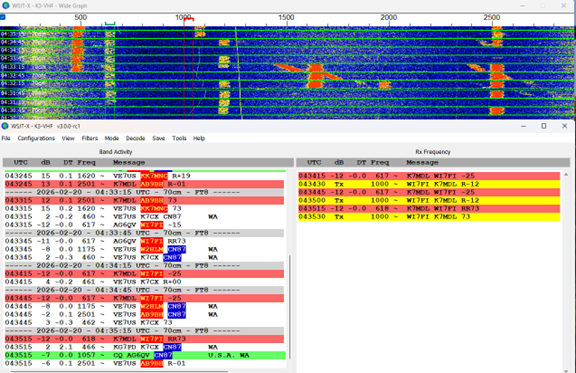
Hello, Treasure Hunters! Ten stations completed all four rounds in the July 2025 NTS Treasure Hunt. They are:
|
 |
|
|
Mug Award Winner for May 2025 is Gary, W9EEU
In previous Treasure Hunts, a special mug was awarded to the first hunter to finish the hunt. We received feedback that sometimes radiograms are inexplicably delayed, and a hunter may end up not finishing first despite their diligence on the hunt. Starting with the November 2024 hunt, the mug has been awarded via a random drawing from all hunters who complete the hunt. The mug winner for the May 2025 hunt is Gary Adams, W9EEU.
There were a few problems which were discovered and remedied this past hunt. The Winlink radiograms got stuck in the system due to some confusion as to where DTN stations were to pick up traffic. This has been fixed.
We still seem to be having problems with getting confirmations (HXC) back from our messages. If you deliver a message to the addressee of a message with HXC, whether on air or any other means, you need to send a message such as an ARL Forty Seven to the originating station.
On to the September Treasure Hunt
The hunt will have 6 rounds this time. Can you get through all six rounds by October 25?
For those of you who have trouble finding a net into the NTS, you are free to use the Radiogram Portal
So here is the first-round question:
NR 1 R HXG AC8NP 24 TIFFIN OH SEP 2
BT
THR1 WHAT IS THE MEANING
OF THE Q SIGNAL QNQ
QUERY REPLY TO GLENN VE1AQF
METEGHAN NS B0W 270
BT
DAN AC8NP
The judges will generally respond with a radiogram back to you within 24 hours of the receipt of your message. Our judges are on traffic nets almost daily. The in-transit time will vary. So, if it has been 4 or 5 days and you do not receive a reply radiogram, try sending a new message with a new message number.
Try to learn about the NTS in your Section. Who is your Section Traffic Manager (STM)? The STM can answer your questions on how to move traffic in and out of your Section.
If you missed the official Treasure Hunt announcement in the December 2023 issue of The NTS Letter, here is a recap: This is a fun, on-air, multi-step competition in which you will respond to a "judge" with your answer to an initial clue or question via radiogram. The judge will reply via radiogram with the identity of the next judge, along with the next question or clue in the hunt.
If you have any comments or suggestions, please email Dan Rinaman, AC8NP, at ac8np@ac8np.com.
|

|
|
|
Recognition Awards Update |
|
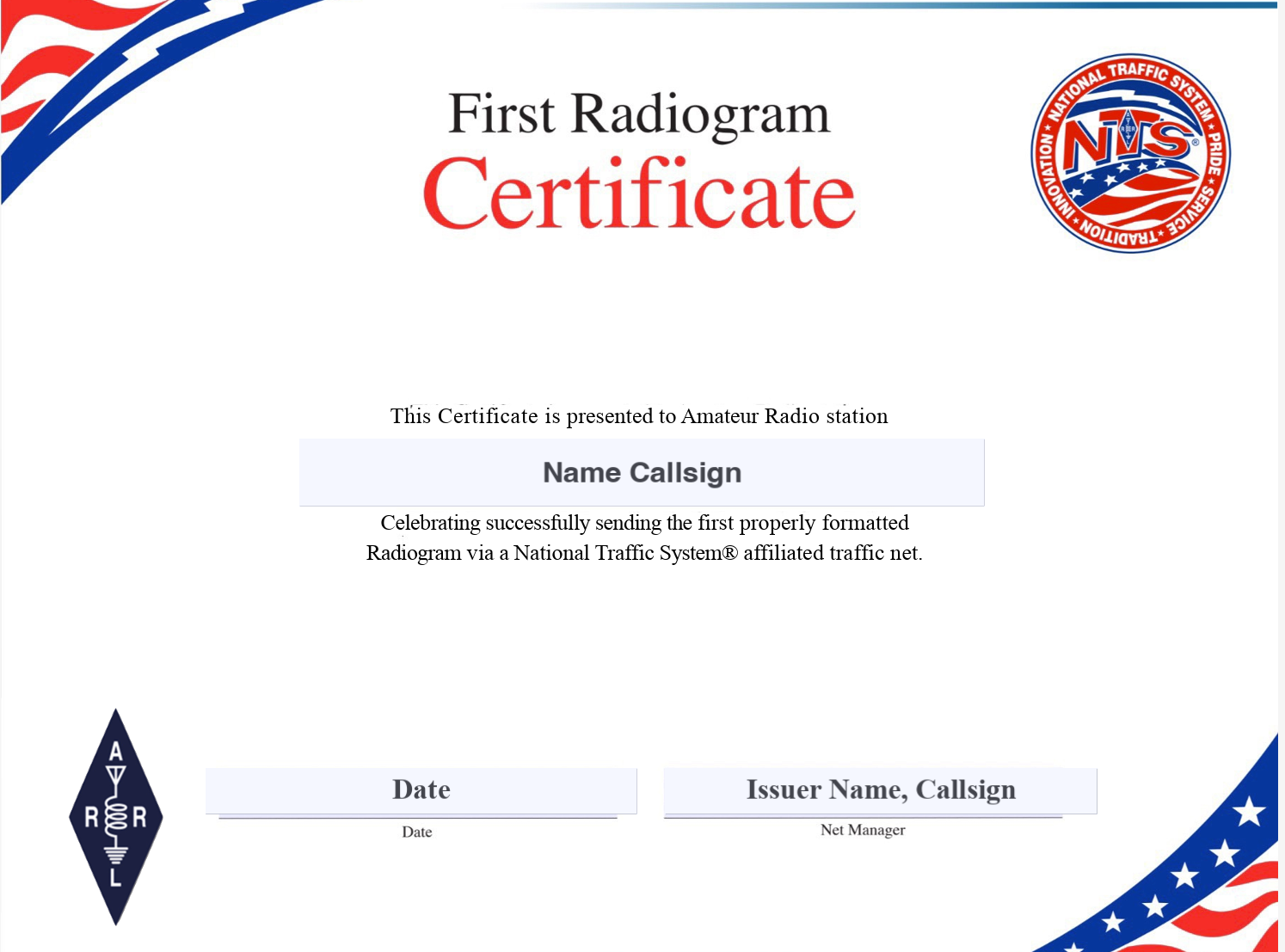
An announcement was made in the June 2025 issue of The NTS Letter concerning new recognition awards for traffic handlers. I hope Section leadership officials are taking advantage of these and rewarding traffic handlers for their time and efforts given to preparation for public service. Perhaps my favorite one is the award for sending one’s first properly formatted radiogram on an NTS net. It takes great effort to learn and great courage to send a radiogram for the first time on a traffic net. Give these newcomers some encouragement and present them with a certificate. Check out nts2.arrl.org/recognition-awards
for more information on downloading these certificates.
|
|
|
|
First Radiogram Certificate | | | |
|
Challenge Coins are also now available to be presented to qualified recipients who have submitted 48 monthly Section Activity Reports (SAR) to their Section Traffic Manager. STMs can now obtain these coins by contacting Steve Ewald at WV1X@arrl.org. These are very nice-looking coins you can display in your ham shack.
|
|
The Radiogram Portal Update |
|
The Radiogram Portal report for July showed a total of 310 messages originated on the Portal and relayed by 30 “radiogrammers.” While many of these messages were ham to ham, there were others with no amateur call signs which we may assume were to or from non-hams. This was good to see as one of the main purposes of the Radiogram Portal is to make the public aware of our amateur radio messaging service.
Thanks to those who have helped spread the word about the Radiogram Portal.
One of those messages, however, emphasizes the importance of keeping the integrity of a message intact.
A delivering station reported calling a phone number relayed to him as part of the recipient’s address information.
Imagine his surprise to find the party at the other end of the line was the originator himself! The originator had given an email address for the recipient but no phone number.
He had, however, provided his own phone number following his signature, presumably in case there was a reply.
However, the radiogram as received by the delivering ham did not include any email address but did include the phone number originally provided following the signature.
Fortunately, all ended well, but could have resulted in a lost message.
|
|
|
|
NTS Happenings in New England |
|
Ham radio operators are a social bunch, and in early August we held an annual traffic handlers picnic in Concord, Massachusetts.
Folks from Massachusetts, Rhode Island, Connecticut, and New Hampshire enjoyed meeting face-to-face over food and plenty of conversation.
We were happy to have our New England Division Vice Director, Phil Temples, K9HI, as well as Steve Ewald, WV1X, from ARRL Headquarters, join us.
Both had brought a selection of books which were raffled off to those present.
It was a perfect New England day weatherwise, and all had a good time.
Also in August, we held our annual Northeast HamXposition in Marlboro, Massachusetts, a well-attended and very enjoyable event.
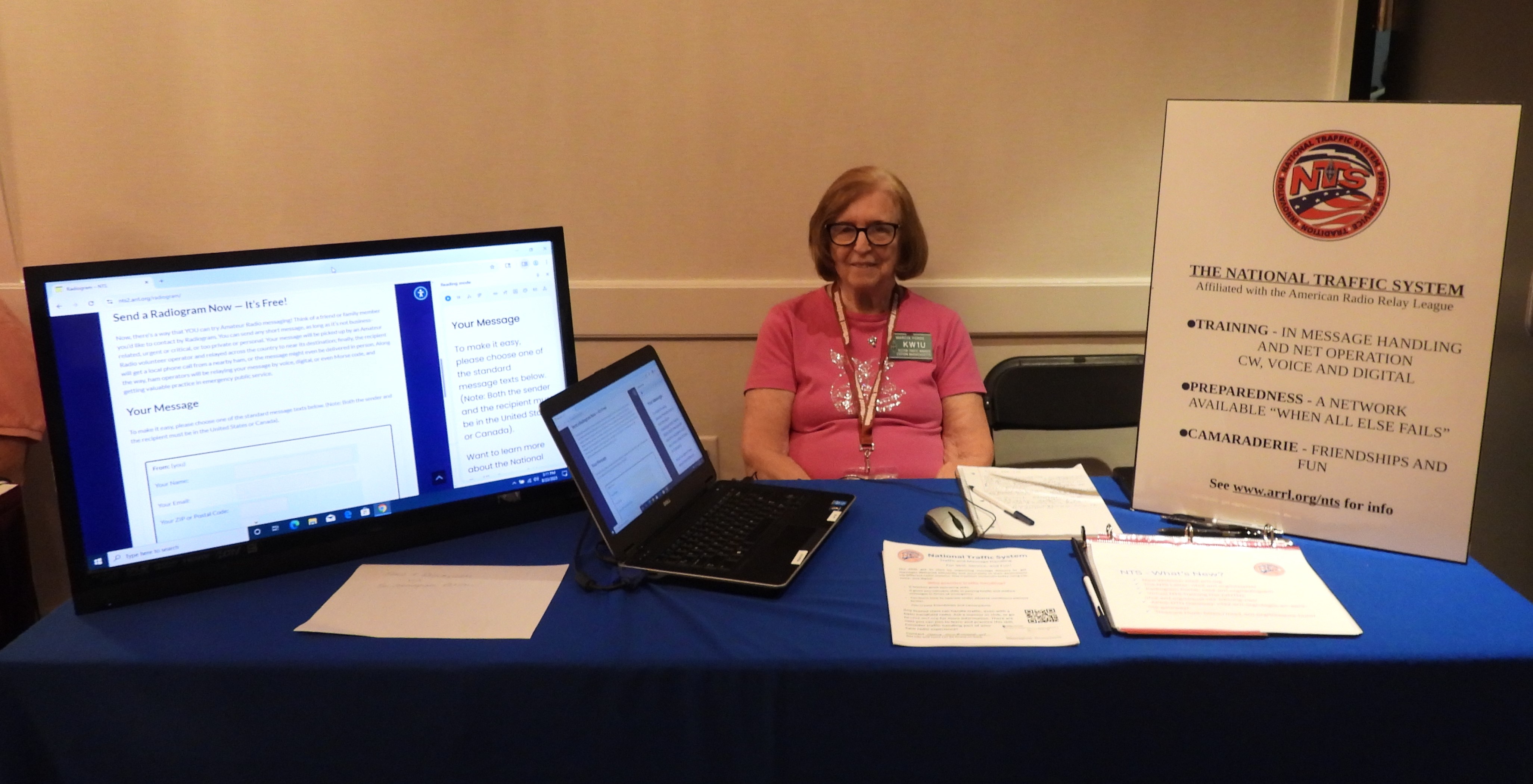
We organized a special NTS table with information on what’s new in NTS, including flyers and a computer which allowed passers-by an opportunity to send radiograms via the Radiogram Portal.
From the interest that was shown, particularly in the Virtual NTS Training Net, we may be seeing some new net check-ins in the near future.
|
 |
|
|
NTS Table at HamXposition | | | |
|
A meet-and-greet forum session was also presented where traffic handlers and potential traffic handlers could talk about what has been going on traffic-wise in New England and around the nation. Official Relay Station certificates were presented to some new Massachusetts traffic handlers. We have seen increased interest in these appointments, due in part to the Cape Cod Traffic Jam, as reported in a previous issue of this newsletter.
Let us know what is happening traffic-wise in your area.
|
|
Numerous complaints have been heard concerning non-compliance with handling instructions, noted in the preamble as HX_. Traffic handlers understand that handling instructions are optional, unlike the six required fields in the header of a radiogram.
However, it is important to note that following these instructions when given is not an option.
They were put there at the discretion of the message originator for reasons important to them.
It is not for us the traffic handlers to judge this importance.
HXC seems to be the most prevalent instruction not followed, leaving the message originator wondering if his/her message was delivered, especially if no service message had been received as well.
Of course, we get busy and occasionally forget, and I’m sure that has happened to most of us at one time or another.
However, we should really be practicing making a habit of following handling instructions.
They are important to the sender and that next message could be from a member of the public to whom we want to show the value of amateur radio.
Individuals who send bulk type radiograms are now generally using HXG instead of HXC on their messages, so no date and time of delivery is required, but remember that HXG still requires a service message such as the “ARL Sixty Seven” standard radiogram, if the message is not delivered.
Another question came up recently regarding a message with a number containing a decimal point, such as 7243.5 kHz. In this case the letter “R” is substituted for the decimal point.
Because a radiogram might be sent by voice, CW or digital modes at any point from origination to destination, it is common usage to substitute the decimal point with the letter “R”, regardless of mode.
Therefore 7243.5 would be sent via CW or digital as 7243R5 or be voiced as “mixed group figure seven two four three romeo five”.
|
|
Spotlight: Jim Wades, WB8SIW, Board Chair, Radio Relay International |
|
I am fond of saying that the closest a man comes to perfection is in his resume or in his obituary.
Needless to say, this is neither, so hopefully, a brief story explaining my involvement with traffic handling will suffice.
My father served in the 15th Air Force, 301st Bomb Group, during World War Two.
While visiting an old friend from the service, my father’s friend took me to a neighbor’s home to see his “ham radio station.” It consisted of a six-foot-high, homemade rack-and-panel transmitter and a Hallicrafters SX-28 receiver. It was love at first sight.
As soon as we returned home, I went to the local library and found a book by Howard Pyle entitled So You Want To Be a Ham. It was the start of an interest in radio that ultimately led to being licensed a couple of years later, thanks to a Novice class conducted through an adult education program conducted by Jerry Blumenthal, W8TWJ. As I had already had some experience with the American Morse Code thanks to the Grand Trunk railroad, the code came rather easy for me, and I found myself operating CW almost exclusively.
The exposure to traffic work came while I was serving as ARRL Emergency Coordinator for Oakland County, Michigan.
During a meeting, one of the ARES members argued, “if you really want to handle traffic, you need to join the Michigan QMN Net.” I took his advice and have been involved in QMN and traffic handling on and off for 40 or more years.
Having been involved in emergency management, both on the professional side and the amateur radio volunteer side, I remain convinced that traffic handling is the best training opportunity available for those involved in public service and emergency communications.
In addition, I find great pleasure in a snappy CW circuit or well-managed traffic net, which, in the hands of good operators, functions like a choreographed dance routine.
With the creation of Radio Relay International in 2016, I have spent considerable time working with an excellent team of volunteers to develop effective peer-reviewed training programs on traffic handling and EmComm related subjects, innovative EmComm programs, and the like.
Our goal is to modernize traffic handling and restore its relevance for a new generation of radio amateurs and those seeking a purposeful use of their two-way radio capabilities.
In addition to RRI, I serve as International President of the Morse Telegraph Club (www.morsetelegraphclub.com), an association of retired telegraph industry employees, historians, and others with an interest in the history of telegraphy and telecommunications.
As time permits, I am also active in the Long Island CW Club which, by the way, is an excellent resource for those seeking to learn CW.
73, JW
|
 |
|
|
The National Traffic System® (NTS®) is a network of amateur radio operators who move information during disasters and other emergencies.
General messages offering well-wishes also move through the NTS® to help test the system and to help amateur radio operators build traffic handling skills.
While the NTS® is primarily set up to serve the United States and Canada, it is possible to move traffic internationally through the NTS® via various local, regional, area, and international network connections.
NTS 2.0
NTS Manual
NTS Methods and Practices Guidelines
Handling Instructions
Numbered Texts
Form Encoding Rules for Form
|
|
Sign Up to Receive The NTS Letter |
|
The NTS® Letter is published monthly and is free of charge to ARRL members. Subscribe: www.arrl.org/opt-in-out
If anyone has not received copies of The NTS Letter by email, be sure to check www.arrl.org/opt-in-out
to confirm that you are opted in. If you don't see The NTS Letter listed among the publications you are opted into, click on "Edit," and you will have the opportunity to check the box to receive The NTS Letter. If you have missed any issues, you can find them all at www.nts2.arrl.org/nts-letter-issues
as well as on the ARRL website.
Editor: Marcia Forde, KW1U, Section Traffic Manager -- Eastern Massachusetts, Western Massachusetts, and Rhode Island
ARRL Director of Emergency Management: Josh Johnston, KE5MHV
|
|
NTS® is a program of ARRL The National Association for Amateur Radio®. No other organization works harder than ARRL to promote and protect amateur radio! ARRL members enjoy many benefits and services including digital magazines, e-newsletters, online learning (learn.arrl.org), and technical support.
Membership also supports programs for radio clubs, on-air contests, Logbook of The World®, ARRL Field Day, and the all-volunteer ARRL Field Organization.
|
|
The
NTS Letter is published every month (12 times each year). ARRL members may subscribe at no cost or unsubscribe by editing their Member Data Page at
www.arrl.org/opt-in-out.
Copyright © 2025 American Radio Relay League, Incorporated. Use and distribution of this publication, or any portion thereof, is permitted for non-commercial or educational purposes, with attribution. All other purposes require written permission.
|
|

.png?cb=646224)
.png?cb=841455)


